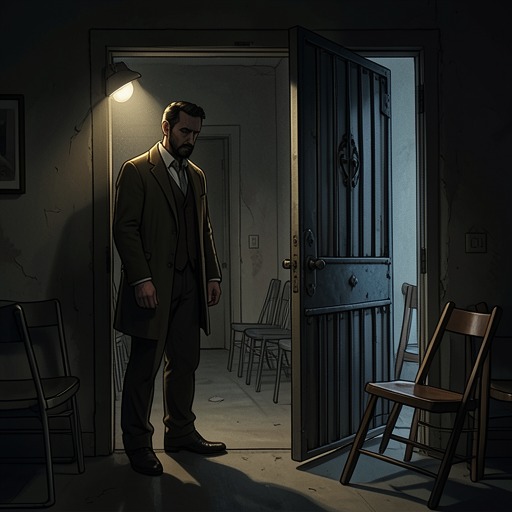
The night of 21–22 September
The Seven Dials MysteryThe night of 21–22 September is the pivotal interval between Gerald Wade writing a private letter and being found dead the following day. The date fixes the letter to the eve of his death, while its account of his health and his warning about Seven Dials unsettle the initial explanation of a Chloral overdose. The night matters both as the time of the death and as the point from which the mystery must be read backward.
Date and Sequence
The date on the letter is September 21. When Bundle Brent later found it, she recognized that Gerald Wade had been writing on the very evening of the tragedy: he was found dead on September 22. The surviving evidence establishes this sequence but gives no precise hour for either the writing or the fatal dose.
That small interval gives the letter its force. It is not a distant recollection or a message composed after events had become clear; it is an unfinished account written immediately before the death it would later help to question. The reader encounters the date through Bundle’s discovery, so the night is reconstructed retrospectively from a document recovered after the fact.
The Unfinished Letter
The sheet was crumpled and had been caught in the lower part of a desk drawer that stuck halfway open. Bundle worked a paperknife into the narrow crack and pulled the letter free. Its opening was addressed to Loraine Wade, and Gerald said he expected to come down on Wednesday and was feeling exceptionally fit and pleased with himself. He looked forward to seeing her.
The letter then turned to Seven Dials. Gerald urged Loraine to forget what he had previously said about it, explaining that he had thought the matter was nearly a joke but now believed it was serious business in which someone young should not be involved. He began to add something else, but wrote that he was so sleepy he could not keep his eyes open. The page breaks off while he is starting to mention Lurcher, leaving that thought unfinished as well.
Death and Initial Explanation
The contrast between the letter and the reported death is the night’s central disturbance. Gerald had described himself as well, yet wrote that he was overcome by sleep; by the next day, he was dead. A doctor judged an overdose of Chloral the likely cause, noting that the substance, a bottle, and a glass were beside the bed. An inquest would have to follow, but this was an initial medical assessment, not a complete account of what had happened.
Bundle recognized the conflict in the evidence: if Gerald’s description of feeling fit was true, the heavy dose that kept him from waking required explanation. The letter therefore does more than mark the last night of his life. Its two apparently incompatible details—his confidence in his health and his sudden sleepiness—make the ordinary account of the death feel incomplete, while his warning about Seven Dials points beyond the bedroom to a wider danger.
The Letter’s Later Significance
The night’s importance extends beyond the discovery in the desk. At a later meeting, Mr. Mosgorovsky referred to a newly found letter by Gerald Wade that mentioned the organization and asked who had found it. The question shows that the document had significance to people connected with the very subject Gerald had urged Loraine to avoid. What began as a private, unfinished message thus became a point of exposure: its date ties it to the eve of his death, and its warning links that night to the concealed business of Seven Dials.